

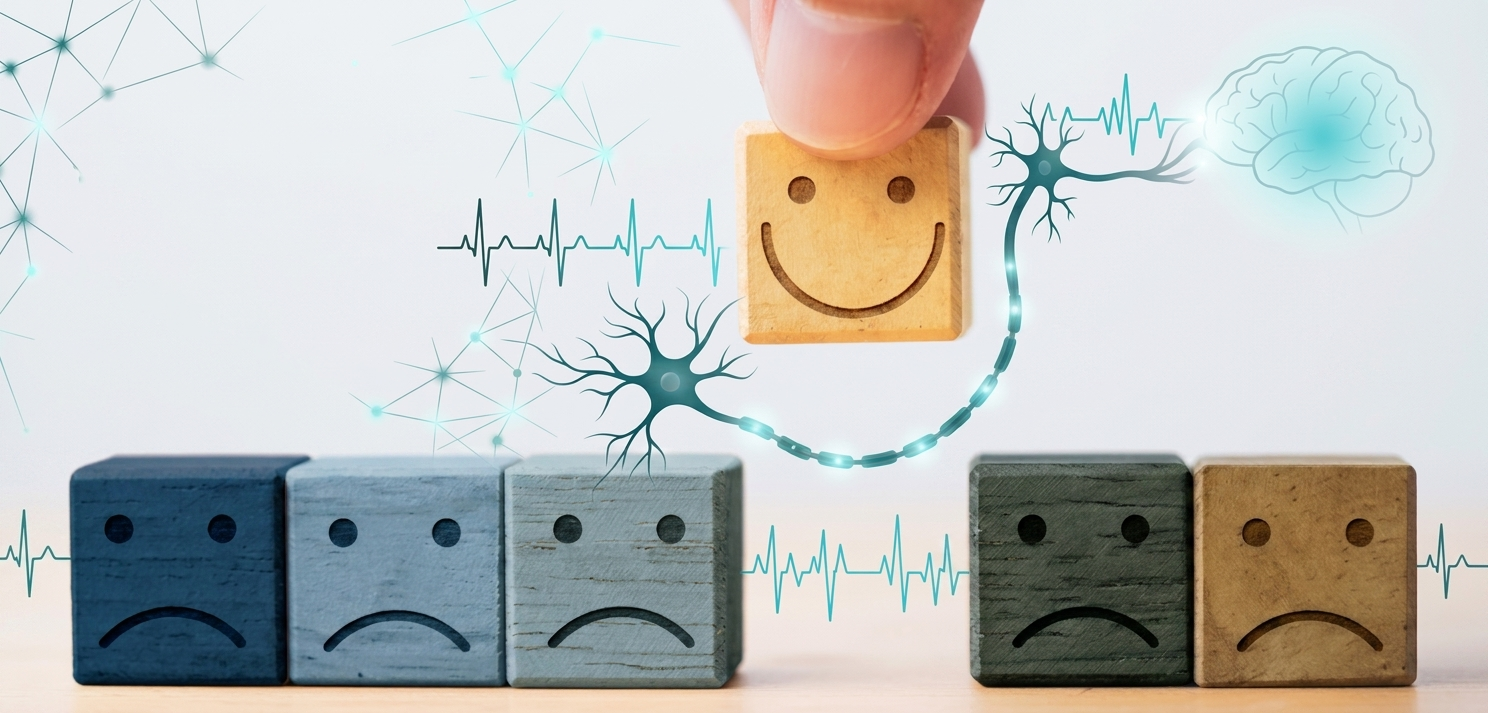
Before reading further, pause for a moment and bring your attention inward. Notice your heartbeat, your breath, and the tension or relaxation in your body. What are you feeling right now? — not what you are thinking, but what you are truly feeling. This simple practice taps into the neuroscience of emotions, helping you connect with your body and inner state.
Neuroscience shows that emotions are always active, influencing perception, attention, and decision-making before conscious thought emerges. They are not obstacles to reason; they are the brain’s first language for survival, connection, and adaptation. This realization is the first step toward emotional mastery: observing emotions without judgment.
1. What Neuroscience Tells us about Emotions:
Historically, emotions were seen as irrational forces opposed to reason. Modern neuroscience challenges this view. Antonio Damasio (1994) demonstrated through studies on patients with ventromedial prefrontal cortex damage that emotions are critical for decision-making; without them, logical reasoning alone fails to produce adaptive behavior.
Emotions are integrated brain–body states that emerge from:
- Sensory input from the environment
- Bodily signals from the autonomic nervous system
- Memory and prior experiences
- Predictions about outcomes
In short, emotions answer the fundamental question: “What does this situation mean for me?” They are not reactions to the world but predictive responses shaped by both biology and experience.
2. Emotion Mechanism — How the Brain Creates Emotions:
Rapid Appraisal and Sensory Processing:
Emotional processing begins the moment sensory input reaches the brain. Joseph LeDoux’s research (1996, 2012) demonstrates two parallel pathways: a fast, unconscious route from the thalamus to the amygdala, and a slower cortical route through the sensory and prefrontal cortices. The fast route allows rapid responses to potential threats or rewards, while the slower route incorporates context and learning. For example, a sudden shadow may initially trigger a startle response before your conscious mind recognizes it as harmless.
The Amygdala — Salience Detector:
The amygdala detects emotionally significant stimuli, not just fear. Facial expressions, social rejection, unexpected rewards, and uncertainty strongly activate this region (Adolphs, 2002; Eisenberger et al., 2003). For example:
- Facial expressions provide immediate social cues. The amygdala responds even to subliminal emotional faces, signaling safety or danger before awareness.
- Social rejection triggers the dorsal anterior cingulate cortex and insula, overlapping with pain-processing networks, explaining why exclusion hurts biologically (Eisenberger et al., 2003).
- Unexpected rewards activate dopaminergic circuits, particularly the ventral tegmental area and nucleus accumbens, reinforcing learning and motivation (Schultz, 1998).
- Uncertainty engages the amygdala, insula, and anterior cingulate cortex, increasing vigilance and anxiety (Hsu et al., 2005).
The Hypothalamus — Body Activation:
The hypothalamus triggers autonomic responses that give emotions their bodily signature:
- Increased heart rate prepares muscles for action.
- Shallow or rapid breathing supports oxygen delivery and alertness.
- Muscle tension or release readies the body to move or relax.
- Digestive shifts occur as blood is redirected to essential systems (Porges, 2011).
These physiological changes are why emotions are experienced as felt states before we can label or reason about them.
The Insula — Feeling the Feeling:
The insula integrates internal bodily signals (interoception) with emotional and cognitive input, transforming raw physiological data into conscious feeling (Craig, 2009). Neuroimaging shows that individuals with higher emotional awareness display stronger insula activation, reflecting greater clarity and differentiation of emotions. For instance, two people may have a racing heart: one experiences panic, the other recognizes mild nervousness. This difference stems from insula-mediated awareness.
Prefrontal Cortex — Meaning and Regulation:
The prefrontal cortex (PFC) interprets emotions and guides adaptive response. It integrates emotional signals with memory, goals, and social context, answering: What is happening? Why does it matter? How should I respond? Research shows that PFC-amygdala connectivity underpins the ability to modulate emotional intensity (Etkin et al., 2015). High stress impairs this connectivity, explaining why overwhelm reduces reasoning. This is not a failure of willpower — it is a neurobiological reality.
Why Emotions Often Feel Automatic:
Emotions feel automatic because the brain operates as a prediction machine, using prior experiences to anticipate bodily needs and environmental demands (Barrett, 2017). Emotional pathways are reinforced with repetition; unprocessed emotional experiences remain biologically active and can be triggered in new contexts. From a coaching perspective, this explains why emotional patterns are learned neural habits rather than immutable traits, and why intentional regulation can reshape these pathways.
3. Emotion Regulation — How the Brain Restores Balance:
Emotion regulation is not about eliminating emotions, but about shaping their intensity, duration, and behavioral expression. Neuroscience shows that regulation operates through two complementary pathways — one beginning in the body and one beginning in the brain. Effective emotional mastery emerges when these pathways work together.
Bottom-Up Regulation (Body → Brain):
Bottom-up regulation targets the biological origins of emotion — the brainstem, autonomic nervous system, and subcortical circuits that generate arousal. Because emotions first emerge as bodily states, regulating physiology directly alters emotional experience.
Slow, controlled breathing — especially with extended exhalation — stimulates the vagus nerve, increasing parasympathetic activity and reducing heart rate, blood pressure, and amygdala reactivity. This shift signals safety to the nervous system, allowing defensive circuits to disengage (Porges, 2011). Grounding techniques, such as sensory contact with the environment, stabilize brainstem orientation systems and reduce threat vigilance. Posture and movement further modulate emotional state by influencing muscle tone, proprioceptive feedback, and hormonal release; relaxed, upright posture supports regulation, while rhythmic movement helps discharge excess sympathetic activation.
Bottom-up strategies are particularly effective during high emotional intensity, when cognitive resources are limited and prefrontal regulation is compromised. By calming the body first, these methods restore the neural conditions necessary for higher-order reflection and choice.
Top-Down Regulation (Brain → Body):
Top-down regulation operates through cortical networks — primarily the prefrontal cortex and anterior cingulate cortex — that interpret emotional signals and modulate limbic activity. Rather than suppressing emotion, these regions assign meaning, context, and perspective, shaping how emotions are experienced and expressed.
Cognitive reappraisal involves reframing the significance of a situation, which reduces amygdala activation and alters physiological output. For example, interpreting a racing heart as readiness rather than threat transforms anxiety into focused energy. Affect labeling — the simple act of naming emotions — has been shown through fMRI studies to decrease amygdala activation while increasing prefrontal engagement, strengthening regulatory control (Lieberman et al., 2007). Language acts as a bridge between raw affect and conscious awareness, organizing emotional experience rather than overriding it.
Top-down strategies are most effective when emotional arousal is moderate, allowing cognitive systems to remain online. When combined with bottom-up regulation, they enable durable emotional learning and adaptive behavior. When an emotion shows up, calm your body first, notice what you feel, and let meaning come later — because when you meet emotions with presence instead of fighting them, they stop pushing you and start guiding you.sponses. When you strengthen this network, emotions stop hijacking your behavior and start informing your choices, fueling growth, and deepening connection.
The 3-Step Neural Rule for Dealing With Any Emotion:
Regulate the body first (Bottom-Up): Before thinking, signal safety. Slow your breathing (longer exhale), feel your feet, soften your shoulders, or introduce gentle movement. Neuroscience shows that calming the autonomic nervous system reduces amygdala reactivity and reopens access to the prefrontal cortex. Without this step, the brain cannot reflect — it can only react.
Name what you feel (Bridge): Once arousal drops, put simple words to the experience: “This is anxiety.” “This is frustration.” Affect labeling engages prefrontal networks and reduces limbic intensity. Naming does not weaken emotion — it organizes it.
Reframe only when calm (Top-Down): Now ask: “What else could this mean?” Reappraisal works only after the nervous system settles. Meaning follows regulation — never the other way around.
In moments of stress, you often try to think your way out of your feelings — but this rarely works because the thinking brain temporarily goes offline. When you calm the body first, emotional intensity softens naturally, and insight arises without effort. Emotions are not regulated by fighting them with logic. They are regulated by restoring a sense of safety in the nervous system — and when safety returns, clarity follows.
4. Illustrative Scenario —When Emotion Leads Before Thought:
Imagine a competent professional — let’s call her Sara — preparing to speak during an important meeting.
As her turn approaches, her heart rate increases, her breathing becomes shallow, her shoulders tighten, and she feels a slight knot in her stomach. Before she consciously thinks “I’m nervous”, her body has already shifted into a state of heightened arousal. From a neuroscience perspective, her amygdala has detected salience (social evaluation), the hypothalamus has activated autonomic responses, and her insula is translating these bodily signals into a felt sense of unease.
At this moment, two pathways are possible.
Path 1 — Automatic Reaction:
If Sara interprets these sensations as danger — “This means I’m not ready” — her prefrontal cortex becomes less effective. Emotional intensity increases, working memory narrows, and she may rush her words, avoid eye contact, or remain silent. Later, she criticizes herself, reinforcing the neural association between speaking and threat. The emotional pattern strengthens.
Path 2 — Regulated Response:
Instead, Sara pauses and gently lengthens her exhale. This single act begins to downshift autonomic arousal via vagal pathways. She silently labels the experience: “This is activation, not danger.” That simple naming engages her prefrontal cortex and reduces amygdala reactivity. The bodily sensations soften — not disappear but become manageable.
Now her brain reinterprets the signals as mobilized energy, not threat. Her voice steadies, she speaks clearly, and afterward her nervous system registers a new outcome: expression did not lead to harm. With repetition, this experience reshapes prediction circuits. What once felt automatic begins to feel navigable.
What This Scenario Reveals:
- Emotions begin in the body, not in conscious thought.
- Regulation is not suppression — it is neural coordination.
- Awareness plus small physiological shifts can change meaning, not just behavior.
- Repeated regulated experiences rewrite emotional predictions.
This is emotional mastery in practice — not controlling emotions but working with the nervous system that creates them.
This scenario shows a core neuroscience truth: change doesn’t start with insight alone — it starts with your regulation. When you notice emotional signals early and respond with awareness instead of judgment, your emotions stop being obstacles and become valuable information. Over time, your brain learns new predictions, making your emotional life more flexible, resilient, and aligned with what truly matters to you.
5. Emotional Intelligence Through the Neural Lens:
Imagine noticing your emotions before they take over — feeling your heart race, your breath shortens, or a tightness in your shoulders — and then choosing how to respond instead of reacting automatically. This ability is what we call Emotional Intelligence (EI), and neuroscience reveals it is rooted in the wiring of your brain.
Your emotions are born in the amygdala, shaped by bodily signals via the insula, and interpreted through the lens of the prefrontal cortex (PFC). The anterior cingulate cortex (ACC) monitors conflicts, errors, and social feedback, helping you adjust responses in real time. When these regions communicate smoothly, you don’t suppress feelings — you coordinate them, making them guides instead of obstacles.
High EI is not about having fewer emotions; it’s about having a brain network that works in harmony. Strong PFC–Amygdala connectivity lets you regulate intensity. A well-tuned insula increases emotional awareness. An active ACC fosters flexible, socially intelligent responses. When stress strikes, these connections can weaken — that’s why emotions sometimes feel overwhelming.
The good news: your emotional brain is trainable. Coaching and practical exercises reshape neural circuits, enhancing your EI:
- Mindful awareness teaches your insula to sense emotions clearly.
- Affect labeling engages the PFC, calming overactive amygdala responses.
- Body scanning and controlled breathing regulate bottom-up arousal at its source.
- Cognitive reappraisal strengthens top-down control, helping you reinterpret emotional meaning.
- Relational regulation — how you interact with others — trains your ACC, sharpening adaptive responses.
Think of EI as a muscle of the brain: the more you practice, the more your neural pathways support flexible, resilient, and value-aligned re
Final Insight:
Emotions are not disruptions to rational thought — they are the brain’s earliest guidance system. By observing, naming, and regulating emotions, we gain access to learning, creativity, and meaningful action. Neuroscience teaches that mastery over emotion begins with awareness, supported by practice and safe experience. When we harness emotions rather than resist them, they become powerful catalysts for personal growth, connection, and sustainable transformation.